
24/03/2016
I saw Kanchana Sita, as a college student, before Ibrahim Alkasi, chairman of the National Film Award Jury (1978), hailed G. Aravindan as "the director who opened the eyes of Indian cinema," and Chidananda Dasgupta described him as "the Shakespeare of Indian cinema."
I saw the film, repeatedly, on all the five days it was screened in Thiruvananthapuram as noon show. Its impact on me was mesmerizing. Like many others, I too believed that Aravindan was the God who came to catapult Indian cinema into the international lime light, overnight.
Only till I saw Hiroshima mon amour, La Strada, Rashomon, Umberto D. and Ajantrik - all of them made before Aravindan might have even thought of making films- Stalker, made one year before Aravindan made Kanchana Sita, and The Sacrifice, made in the same year Aravindan made Chidambaram.
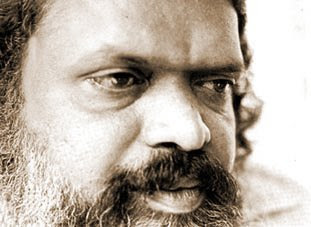
Meanwhile, Aravindan directed films in quick succession. I liked Thampu. But I was shocked to read, later, that Aravindan, at some point, had felt that he should have edited out at least two reels from the final print! Remember, the film had won him the national award for direction (1979).
Kummatty was made for children. Children didn’t understand it; grown-ups didn’t enjoy it. Esthappan won the Best Film Award (1979) at the State-level. However, the film had nothing specific to communicate- material or spiritual- except that it flirted with some Biblical references. But its structure reminded me of Rashomon. I wondered how my God could ever be a plagiarist. I consoled my disturbing thoughts with a counter thought that great men think alike; time no matter.
Then came Pokkuveyil. The film was about the inner emotions of a young man who was inching towards insanity. Like in Kanchana Sita, I found that the actor Aravindan chose to play his protagonist had the right physical appearance but didn’t have the artistic capability to deliver the character.
More importantly, for Pokkuveyil, Aravindan got the music recorded first, and visuals were shot, subsequently, to suit the musical scores. The film won him the State award for direction. But I found many shots in the film going astray and the director chasing them. And I doubted my God.
I then decided to see Kanchana Sita, the film that created the God, once again, six years after I had first seen it. The re-viewing made one thing clear. Magic cheats us.
Rama is the purusha and Sita is the prakriti. While Aravindan chose a man to play the character of Rama, his Sita was nature. But when he showed the leaves swaying in breeze and the river and valley bathed in twilight to evoke the presence of Sita, I found him restricting nature to the commonsensical perception of beautiful images.
And when he showed a golden sculpture of Sita at the yaga site, Aravindan was lobbing a self goal. Though hailed as an enriched philosophical interpretation, Kanchana Sita is a miserably failed attempt to interpret the Sankhya thought of Indian philosophy.
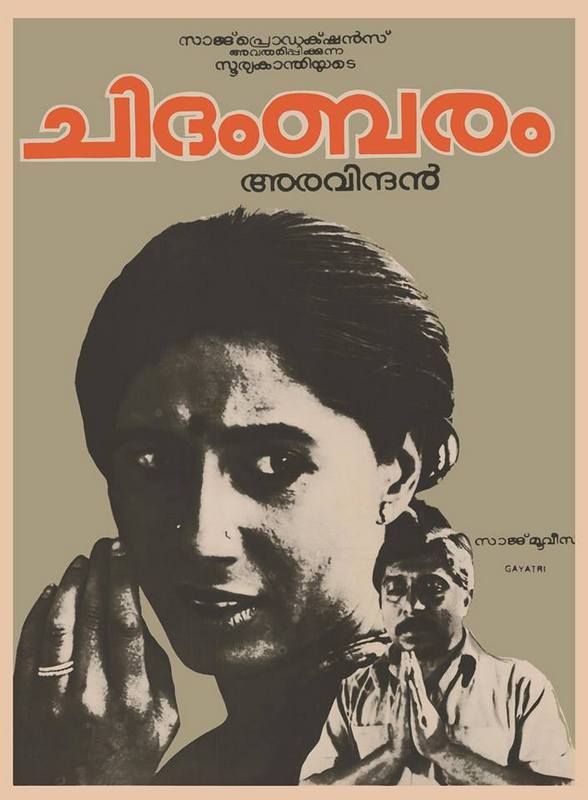
Four years after the release of Pokkuveyil, Aravindan made Chidambaram. It was his production. May be the reason why he eschewed the Kuleshovian thought that what he wanted was "not actors but people who know how to behave." This time the lead roles were played by Bharat Gopi and Smitha Patil. But what Aravindan could bring out from the exceptionally talented actors was something very ordinary.
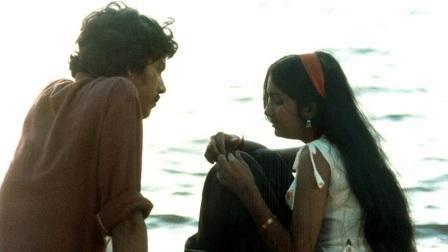
A scene from Pokkuveil
I then thought of the terrific performances of Antony Quinn (La Strada) and Toshiro Mifune (Rashomon and Throne of Blood.) Surely, it needs great film makers to extract the best from equally great actors.
Aravindan’s last film, Vasthuhara, too starred seasoned actors like Mohan Lal and Neena Gupta. For the first time, his characters breathed life. I thought my God was finally going to deliver.
But then death had other plans.
Meanwhile, I started working for Ph.D. on the structure of Battleship Potemkin and Stalker, applying the theories of Intellectual Montage and Mise-en-scene. Though I left the program half-way through (due to personal and political reasons), I had, by then, started viewing films from an academic angle; trying to locate the sense of film through its form.
It was natural that I deconstructed the films of Aravindan. I found them skin-deep in philosophy, pretentious in art and amateurish in craft.
Today, as tributes are being paid to the great film maker on the 25th year of his death, I realize with repose that my God was stillborn.