
20/04/2016
Much to our melody chagrin, the female solo songs are fast becoming a thing of past—and, if the trend continues, we will soon see a complete silence of our beloved nightingales who over the years have sweetened Malayalam cinema with their melodious voice.
Change, they say, is the only permanence in life. Yes, but the waning of female solo film songs is not the change most of us would cherish.
Sadly, it is true.
If you check any current list of popular films songs, only 10% to 15% of them will be female solo songs.
Agreed, the number of songs in films has dropped from an average of five or more from the 1950s to maybe two now. While the male solo songs and duets are still in vogue, the number of female solo songs in films has gone down in spite of the female singers being as talented as their male counterparts.
As Malayalam films have begun to experiment with themes different from the run-of-the-mill concept of hero, heroine and villain, songs have been pushed to the background. Instead of characters singing, often songs are played in the backdrop while the narration goes on. Since the focus has shifted to the visual, the emotions of a song depend on the mood of the scene. Earlier, 'background songs' were used when titles scrolled.

K.S. Chitra
Gone are the days when evergreen heroes like Prem Nazir pronounced each word of the song clearly accompanied by his idiosyncratic mannerisms. Of course, the instances of actors singing are yet to disappear fully from films. Films without songs have become common, something which has hitherto been associated with the so-called 'art movies.'
The change seems to have impacted the female solos the most. Current music directors are moving with the flow. According to Bijibal, one of the busiest music directors now, the trend of characters singing songs looks dated and unreal. In the new setup, he admits that directors increasingly prefer male voices or duets.
Right from the time of 'Balan,' the first talkie in Malayalam in 1938, female solo songs have been a significant part of Malayalam films. Interestingly, the most popular song in Balan, "jathakadoshathale" was sung by M.K. Kamalam. Later in 1954 when music director K. Raghavan 'liberated' Malayalam film songs from the influence of Tamil and Hindi in the landmark movie 'Neelakkuyil,' he saw that female solos didn't lose prominence. 'Ellarum chollanu' and 'kuyiline thedi' by Janamma David were as popular 'kayalarikath' and 'engine nee marakkum' by male singers.
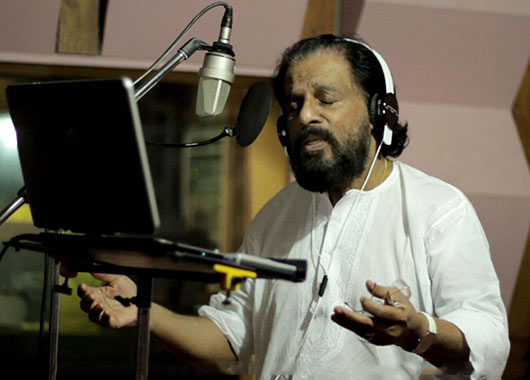
K.J.Yesudas
In the 1960s emerged a phenomenon called K.J. Yesudas, who charmed and dominated the Malayalam song field for next three decades. From that time, female playback songs began to play second fiddle to those by male singers. Yet, there was no dearth of melodies from female singers. After P. Leela, the quartet of non-Malayalee singers S. Janaki, P. Susheela, Vani Jayaram and P. Madhuri sweetened the films with their mellifluous voice.
Kerala's own nightingale K.S. Chitra kept the kite flying for the female playbacks in the '80s. She was joined by Sujatha a decade later. The first signs of sidelining female solos were seen after 2000 with a gradual fall in the number of songs in a film. This trend seems to have strengthened in the last six years or so.
Perhaps, Malayalam songs may be echoing what is happening in Bollywood and other languages. In Hindi, the dulcet voices of Lata Mangeshkar and Asha Bhosle had held their own against the male legends like Mohammed Rafi, Kishore Kumar, Mukesh and others for decades.
Shreya Ghoshal
"This trend is a reflection of the overall change that has happened in our cinema," says Ravi Menon, who has written a number of books on film music. "Today, songs are used more as a tool to promote films. Lip syncing has been discarded, and most of the songs are either group songs or they are used in parts throughout the movie."
Music director Bijibal says that he, along with several other current music directors, has not given short shrift to female solos in films and reels out examples. But the sad fact is that only a very few female solos get into popularity charts. In the recent times, Bollywood singer Shreya Ghosal's songs have been lapped up by the masses to the point that she maybe the most popular female singer in Malayalam films at present.
So what makes the melody queens face the music? Does it have to do anything with the changing times and tastes? Or, is it linked to quality of lyrics, voice and music?
Certainly some food for thought.