
02/05/2016
One of the reasons why the Puttingal Temple officials wanted to go ahead with fireworks display on the fateful day, we are told, was that pyrotechnics were a part of the temple ritual. When the fireworks at Thrissur Pooram just after the Puttingal tragedy was called to question, we again heard the same line of argument – that it's a part of the tradition, that it is ritualistic.
Let's pause for a moment and think about these practices. Personally, I don't think any of the religious practices are antediluvian and eternal. Religious practices, along with gods and goddesses, change over time. Many gory and violent rituals that were once practised widely in South Indian temples have changed over time or ceased to exist altogether. For example, historians talk about a primitive war-goddess Kotravai, who was worshipped in Kerala as recent as four or five centuries back. This goddess had a strange liking for human blood and she was appeased by spine-chilling, macabre rituals. We don't hear about such goddesses anymore. Similarly, at least in Kerala, animal sacrifices have greatly reduced in numbers in the last one or two centuries. Yet, we often hear that the rituals cannot be compromised, that they will have to continue.
But what are the grounds for claiming that these practices are ritualistic? Most, if not all, of the Kerala temple rituals follow a tradition called Tantra. When it comes to temple rituals and festivals, there are medieval texts, considered to be authoritative, and followed by priests and authorities. Surprisingly (or not so surprisingly) none of these texts mentions fireworks, ritualistic or celebratory, even once. There are dozens of texts that are considered authoritative, when it comes to temple rituals. Works like Tantra Samuchaya and Sesha Samuchaya examine and prescribe rituals from older, Sanskrit, texts. Works like Kuzhikkattu Pacha translate and comment on Sanskrit texts. None of these texts mention, let alone prescribe, fireworks among the rituals. It's not a shocker really. The technology isn't very old at least in India. Historians say the expertise and know-how of the firearm technicians reached India somewhere in the 15th century. The texts, upon which the temple rituals are based, are definitely older than that.

Why should the fireworks be treated as a religious ritual then? When it all started, it must've been a harmless celebratory performance. Unfortunately it's not so anymore. What happened at Puttingal was Kampam, a competition between two factions. Every year, the Thrissur Pooram organizers try to outdo themselves in their performance. Fireworks are not a celebratory treat anymore. It's a pompous competition, and a dangerous one at that. It's not an inheritance of a ritual, it's an inheritance of a mistake.
Another practice that's widely justified in the name of ritual is the use of elephants in temple procession. Fact is that like fireworks, the usage of elephants too has no scriptural authority. However, the practice of using elephants in temple processions, or elephants as a cultural symbol, might have deep roots. Firstly, elephant is an important symbol in Buddhism. Apart from being a symbol associated with the legendary birth of the Buddha, an elephant faced god Kangiten is considered as an avatar of Avalokiteshwara by some Buddhist schools. Buddhism flourished in Kerala before today's temple-culture. Secondly, the forests in Kerala had a thriving elephant population. During the medieval period, kings used to generously gift elephants to scholars, artists, common folk, and to generally anyone who were in their good books. It must be the influence of Buddhism coupled with the abundance of elephants that made the beast a cultural symbol in Kerala. It should be noted that Sri Lanka had a very similar history – abundance of elephants and a strong Buddhist culture. Sri Lanka is another region where elephants are a cultural symbol, and is used in religious processions. The point is this: there could be a number of reasons how elephants came to be used in the temple processions and how they became a cultural symbol. But definitely, ritual is not one of those reasons.
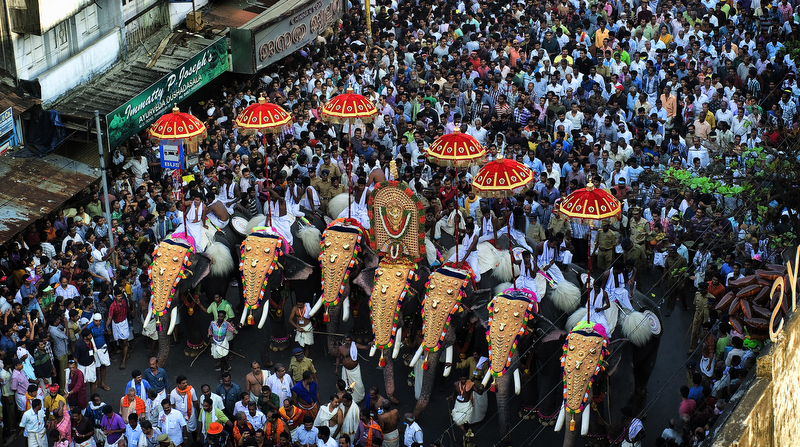
So, if it's not part of the prescribed rituals, what can the law of the land do? As long as there is a society that appreciates these so-called "cultural symbols," there will be a demand for them, and since these are quasi-religious cultural symbols, someone can always defend them in the name of religious sentiments. Even the law would be sympathetic when the idea of religious sentiments is in the picture. Unfortunately, religion always finds a way. One can only hope for a more mature society.
Those who argue that these practices are ritualistic and hence cannot be banned know well that the practices are out-dated. They also know there is something inherently wrong with such practices. Look, for instance, the ban on women's entry at Sabarimala. The very idea is discriminatory and thus unjustifiable. The only way to defend a wrongful practice would be in the name of ritual. If there is no scriptural authority for these practices, how would the argument these are part of the rituals be defended? Well, religion and the religious have their own logic. These rituals are 'raajopachaara'- the customary practices meant for a king, a veteran priest told me. The royal etiquette changes over time, and thus it's not prescribed in the texts. However, you are bound to honour the etiquette. The use of elephants and fireworks are part of raajopachaara. I find that as a lame excuse. We got rid of the monarchy and the royals. We can certainly get rid of raajopachaara.
(Photo credit: Vinod Kumar & forum.linvoyage.com via Foter.com / CC BY)