
22/05/2016
Finally, V.S. Achuthanandan has shown signs of mellowing down.
When the party chose his rival Pinarayi Vijayan as the next Kerala chief minister, V.S. opted not to fight for the position, though his body language exuded a tinge of despair. In fact, he had given enough hints over the past several weeks that as the most popular face of a tireless, high-wattage campaign for the Left Democratic Front (LDF), he wasn't averse to the idea of returning to the coveted chair a second time. Until the party's central leadership thought it wise to pick Politburo member Vijayan for the chief minister, V.S. hoped he stood a chance.
After the Communist Party of India (Marxist) General Secretary Sitaram Yechury announced the party's decision, V.S. fell in line though his composure was the talk of the town – TV channels, probably egged on by misled reporters and trigger-happy anchors, debated the fairness of the action. All of them seemed to expect an imploding *pater familias* to face them over the next few hours or a day. They were disappointed, and even looked demoralized when he didn't.
The next day when V.S. met the media, he didn't complain about being eased out. He thanked the people of the state for their support to him as the Leader of the Opposition and made a few perfunctory statements in response to queries. Amid a flurry of questions, he excused himself and retired to the inner rooms of the Cantonment House, his official residence in Thiruvananthapuram, leaving reporters accustomed to V.S.'s typical ways of confrontation – a wisecrack here and a dig there -- unenthused. He was subdued, in an uncharacteristic display of party discipline, as if he knew the decision long ago.
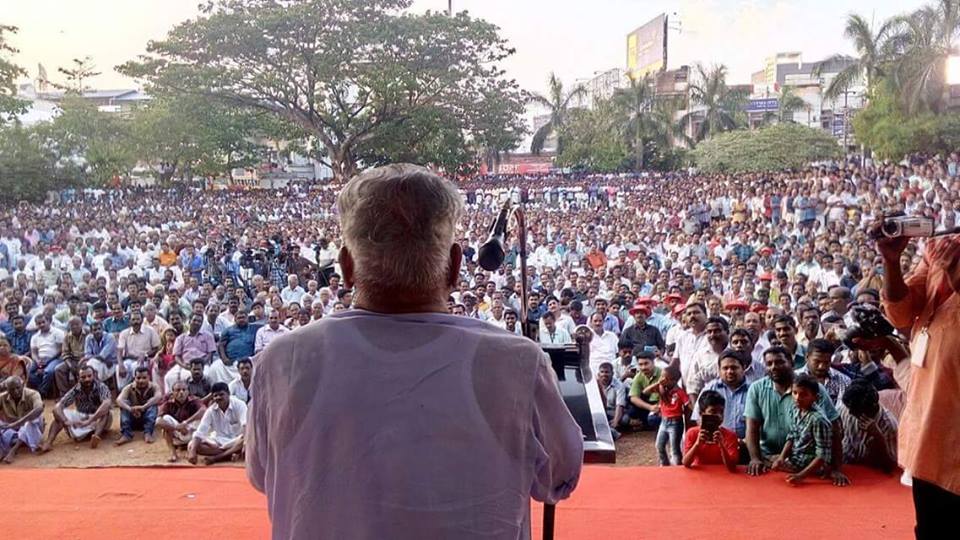
I remember him at the Visakhapatanam Party Congress of the CPI (M) in April last year where he was the biggest attraction for journalists until the final day when Yechury stole the show as the new party chief. During the triennial event, the moment his car stopped at the conference venue or when he stepped out of the meeting hall, there was always chaos, with cameramen, photographers and journalists darting toward him for a sound bite. No doubt, he enjoyed media attention, and he reciprocated too, offering reporters crumbs to lap up at a party meet where most other leaders were tight-lipped. It's not that journalists treated his words like gold dust, as it often was in the case of the late E.M.S. Namboodiripad, but they loved V.S. because he spoke mostly about the party, and because he placed himself as an iconoclast and a rebel. He was sensitive, often overly, to journalistic preoccupations. At this particular summit, he made news congratulating Yechury in advance on his likely election as party chief, much to the anguish of many of his Kerala comrades who had backed S. Ramachandran Pillai to the post.
It is no wonder that he attracts journalists like a magnet.
I also remember his euphoric face in early 2007 --he still had a spring in his step and didn't need any support to walk around -- when he made a veiled attack on Vijayan, who had said that a "media syndicate" was out to tarnish his image. True, V.S. and his band of loyalists within the party had cultivated friendships among reporters and editors of various dailies and TV channels. Vijayan, who was the state secretary then, believed that a section of the media friendly to V.S. was out to malign him, thanks to selective leakage of news by the V.S. camp. V.S. had a winning smile then, that of someone who was destined only to crush rivals. In hindsight, it's not wrong to say V.S. was thick with the media.
Notably, V.S. was inventive with his use of tactics to combat rivals. The media just happened. "He had remained a faction leader who always had enemies to fight within the party," Punnapra-Vayalar struggle veteran P.K. Chandranandan had told me in the 1990s. Chandranandan and V.S. had been bitter rivals, and P.K.C., as the former was popularly known, never actually forgave V.S. for denigrating him. Back when P.K.C. was alive, credentials committee reports of Party Congress meets invariably had his name as the one who had spent the longest years underground. To cut a long story short, V.S.'s antipathy toward P.K.C. had nothing to do with the latter's "bourgeois tendencies." P.K.C. was the perfect Gandhian communist, a true representative of a generation of leaders who had worked selflessly for the party and the people. V.S. dabbled in factionalism and hung a name on his rivals with gusto. Vijayan, who is close to various industrialists, was an easy target for being "pro-capitalist."
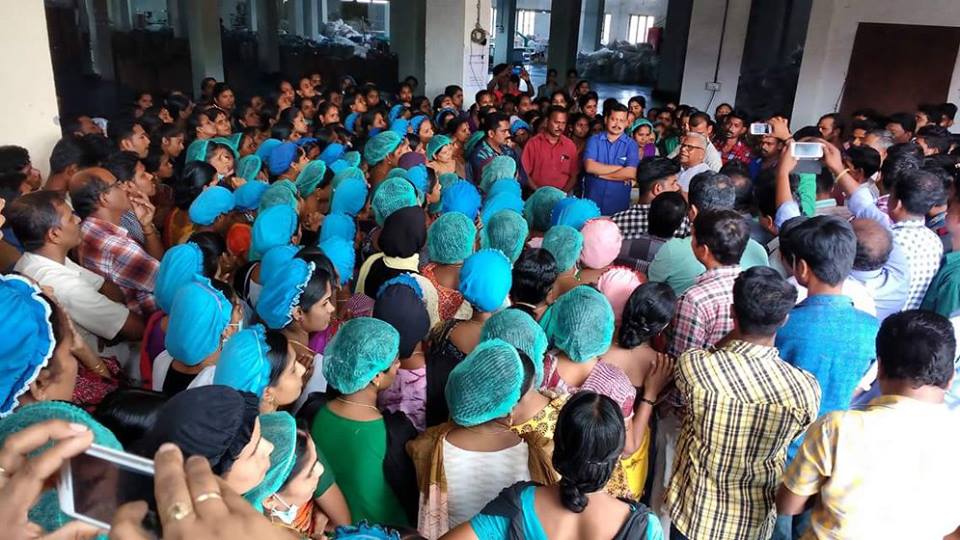
Back in the 1990s and 1980s, V.S. wasn't a darling of the media (which he later became) as he went out tarnishing his rivals in public. He was at times caustic and ruthless in word and deed. For a leader feted as "the last surviving member" of the 30-plus group that walked out of the CPI National Council in 1964 to float a new party, which the Election Commission later named as CPI (M), V.S. was at his irreverent best when he referred to the late P. Ramamurti, founding CPI (M) leader and Politburo member, disparagingly as *"kilavan"* (old fellow) at the 1984 Kolkata Party Congress. Ramamurti had by then been sacked from the Politburo and attended the high-level meet as an ordinary delegate. Many CPI (M) leaders have told me how unrepenting V.S. was when he was chided by senior leaders for making such remarks.
V.S.'s conversations with Gowri Amma in 1964 after the party split, are part of the CPI-CPI (M) lore in Alappuzha. *“Kunjamme, ippol theerumaanikkanam, kettiyon veno, party veno ennu"* (Do you want your husband or party, decide now). That was V.S.'s pithy and earthy assertion to a lady whose husband, the great leader T.V. Thomas, was with the CPI.
In his early years, V.S. was a great organizer and a man blessed with powerful physique. It's said that there is more mention of V.S. in A.K.G’s autobiography, *In the Cause of the People,* than any other leader of his generation.
His ascent to power politics was slow but steady: V.S. rose to become a leader to reckon with in the early 1980s after he became CPI (M) state secretary. He stayed in the post for more than a decade. Though he was unpopular and overshadowed by crowdpullers such as E.K. Nayanar and the whole band of leaders whom he would purge later – M.V. Raghavan, Puthalathu Narayanan, P.V. Kunhikannan, etc. – during this period he gained in popularity among party cadres. It was around this time, especially after 1985, that he struck up a friendship with Pinarayi Vijayan who had by then emerged as a firebrand leader in Kannur district. V.S. soon found a trusted lieutenant in Vijayan in his no-holds-barred efforts to settle political scores within. The rest is history. We all know what happened to leaders such as M.M. Lawrence, K.N. Raveendranath and others in the time of the great purges in Kerala CPI (M) in the 1990s and the noughties.
But Vijayan and V.S. began to lock horns within years of the former assuming charge as state secretary of the CPI (M) in 1998. The early years when Vijayan was at the helm were relatively peaceful, but in the past 10 years of Vijayan's 18-year reign, the bitterness was deep, war of words nasty and both the leaders showed no signs of retreating an inch.
It was as though V.S. had found his match in Vijayan. For, the only leader in the history of the CPI (M) to have successfully taken on E.M.S. in a faction fight and still managed to stay unhurt, V.S. soon saw the ground beneath his feet slipping away. The reasons were myriad: Vijayan is an astute faction leader, too, filling in his own people in key party posts; he had the advantage of age; and perhaps he knew how to keep his mentor at bay within the organization.
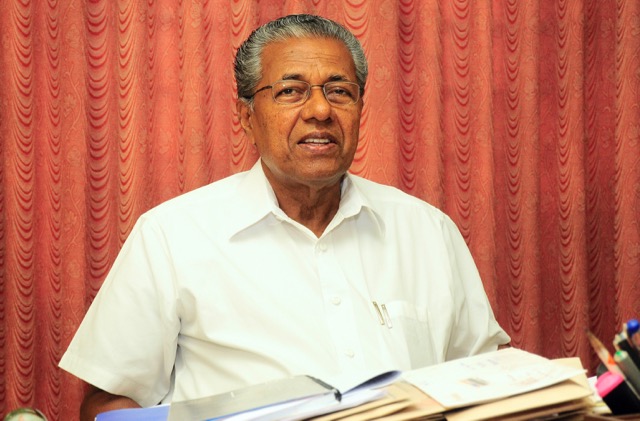
Yet, to V.S's credit, he adapted to new realities soon enough. He understood the "nature" of cadres – that their aspirations and beliefs weren't the same after the fall of the Soviet Union. Within the confines of a Stalinist party structure that he himself assiduously built, there was scope for experimenting with dissent. Unlike his rivals and former loyalists, he had his ear to the ground, like most faction leaders do. He began to vent his woes and air his misgivings at the goings-on inside the party openly. True, he may have attracted disciplinary action, which includes a "demotion" from the CPI (M) Politburo to the Central Committee, but adulation of people for him only grew and his posturing as a crusader against corrupt elements within the party captured popular imagination. His opponents were at their wits' end as he continued to break open the rigidity of the party apparatus and struck a chord with the common man. The romance of nostalgia for the old-time Communist leader fighting tooth and nail revisionists and collaborators within his party was appealing enough to a literate Kerala society. It helped him that the party's central leadership was a divided lot in those years when he battled the powerful Pinarayi group. The outcome was that the state unit had to continue to stomach insults, as its decisions to keep V.S. away from the poll fray were repeatedly vetoed by an infirm top leadership.
The factors that marked the end of the E.M.S. era in Kerala in the late 90s in which V.S. emerged victorious seem to have resurfaced again this time. V.S. is 92-years-old and needs help to walk. Most importantly, the central leadership is now cohesive about what to do with him. As someone whose fate in the party had been long hinged to that schism, V.S. immediately understood that with Kerala as the last outpost of the CPI (M), the levels of tolerance for the central leadership for his methodic madness is pretty low.
The sun isn't yet set for V.S., but he leaves behind a chequered legacy of a Marxist leader who was more in love with himself than his professed causes. Still, V.S. should feel content that he has used his immense popular appeal to clinch a much-needed victory for his party. And he will be remembered for that because it was no mean feat.
*(Photos of V.S. are from Facebook pages on him)*